MyExo in Orthopaedics and Sports Medicine: Tendons, Ligaments and Joints

Beyond aesthetics, autologous exosome-rich plasma is applied in musculoskeletal and orthopaedic medicine: tendinopathies, muscle tears, ligament injuries and early osteoarthritis.
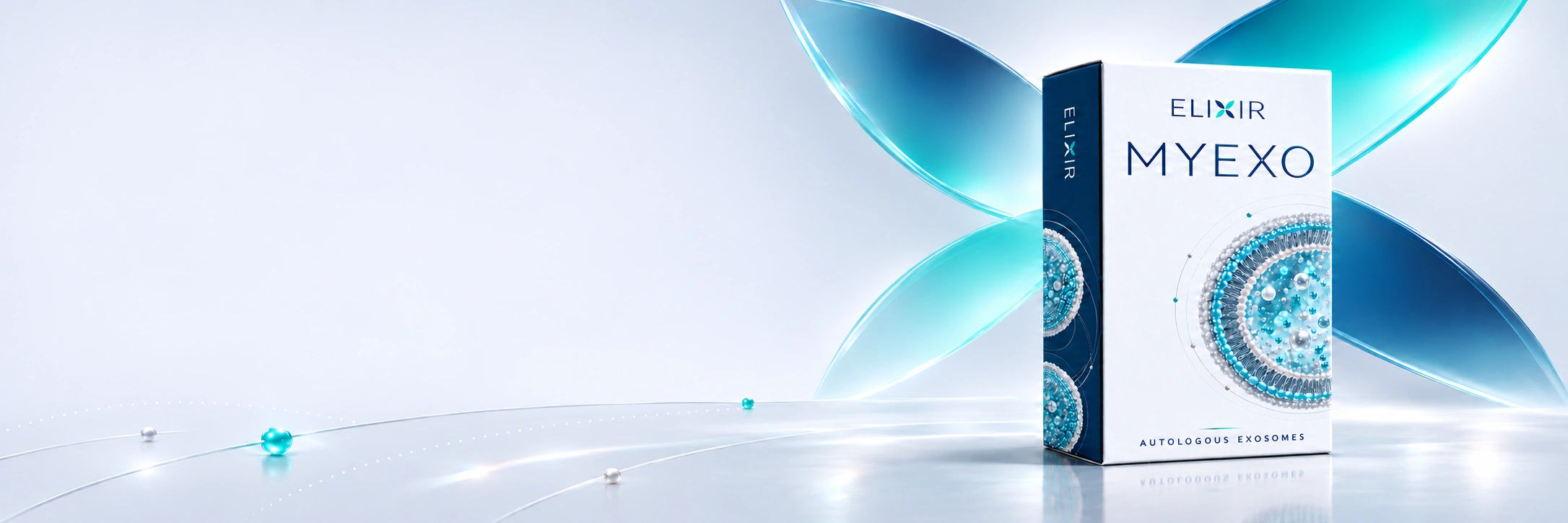
MyExo delivers 12 trillion exosomes in a 10 mL final volume, with an average exosome size of 120 nm (±15).
Mechanisms relevant to orthopaedics
Exosomes promote chondrocyte metabolism, reduce synovial inflammation and accelerate tendon remodelling, improving functional recovery.
Inflammation resolution
Exosomes influence macrophage polarisation by suppressing pro-inflammatory cytokines (IL-1β, TNF-α) and increasing anti-inflammatory mediators (IL-10, TGF-β). This limits tissue damage and accelerates the transition from inflammation to remodelling; clinically, this correlates with decreased swelling, improved perfusion and early pain relief.
Structural remodelling
Fibrin, exosomes and growth factors together form a temporary three-dimensional scaffold for cell migration and matrix organisation. The aim is structurally integrated, vascularised, functionally mature tissue rather than fibrotic scar.
Pain and inflammatory disorders
By acting directly on inflammatory mediators and promoting tissue repair, autologous exosomes are positioned as a biological alternative to pharmacologic pain control in osteoarthritis, tendinopathies and chronic soft-tissue injuries.
Practical advantages
- Minimally invasive: simple venipuncture and local administration
- Closed-system, point-of-care preparation in about 30 minutes
- ≥89% recovery with 5.5–6× concentration from 40 mL of blood (manufacturer data)
- Fully autologous and non-immunogenic
Learn more about the kit, its components and laboratory characterisation on the MyExo product page, or contact our team on WhatsApp +971 52 124 4440.
What the Research Says
A 2025 study from the University of Iowa, published in The Orthopaedic Journal of Sports Medicine (Song et al.), followed 58 patients with mild-to-moderate knee osteoarthritis (Kellgren-Lawrence grades 1–3) after a single ultrasound-guided PRP injection, and analysed the exosomes inside each patient’s PRP.
- 73% of patients achieved at least a 20% reduction in knee pain at 12 weeks
- Responders also improved more in physical function, self-efficacy and daily-living scores, and in a timed sit-to-stand test
- Among patients who started with clearly unacceptable pain, responders had a larger average exosome size than non-responders (80.8 vs 78.0 nm)
- Response was linked to exosome size, not to platelet count or raw exosome concentration
- Exosomes from PRP were taken up by human cartilage cells (chondrocytes) in the laboratory, a requirement for biological activity
This study used conventional PRP, not MyExo. Its message is relevant to MyExo, though: the character of the exosomes, which depends on how they are prepared, matters as much as how many there are. The authors call for further work on exosome content and on longer-term joint outcomes.
Reference: Song I, Glass NA, et al. The Effect of Exosome Size in Platelet-Rich Plasma on Outcomes in Patients Treated for Knee Osteoarthritis. Orthop J Sports Med. 2025;13(9):23259671251360410. doi:10.1177/23259671251360410
For healthcare professionals. Product information is provided by the manufacturer (t-lab) and is general in nature; it is not medical advice. Treatment decisions should be made by a qualified physician. MyExo by Elixir is distributed by Bionics Medical in the UAE and Saudi Arabia.