

577 nm Yellow Laser and FlexSys: The Science, the Evidence and Safety in Darker Skin

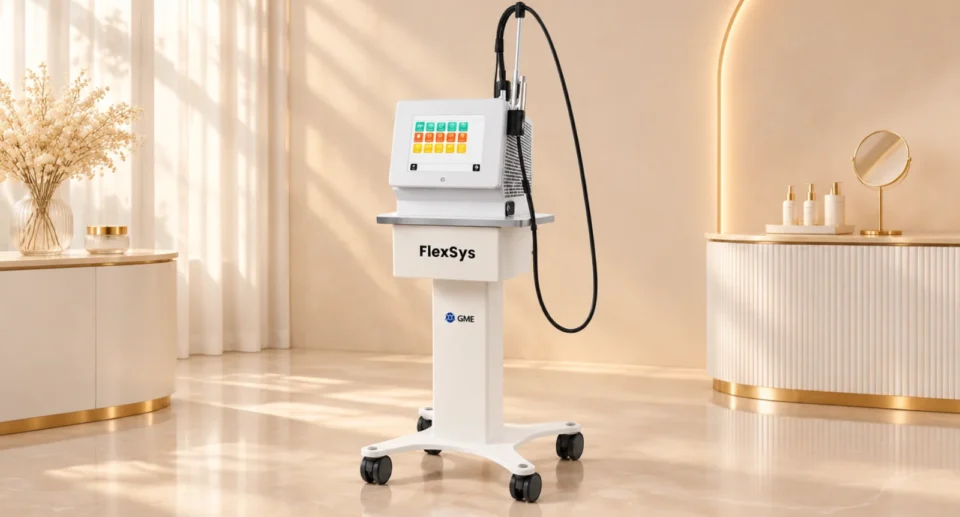
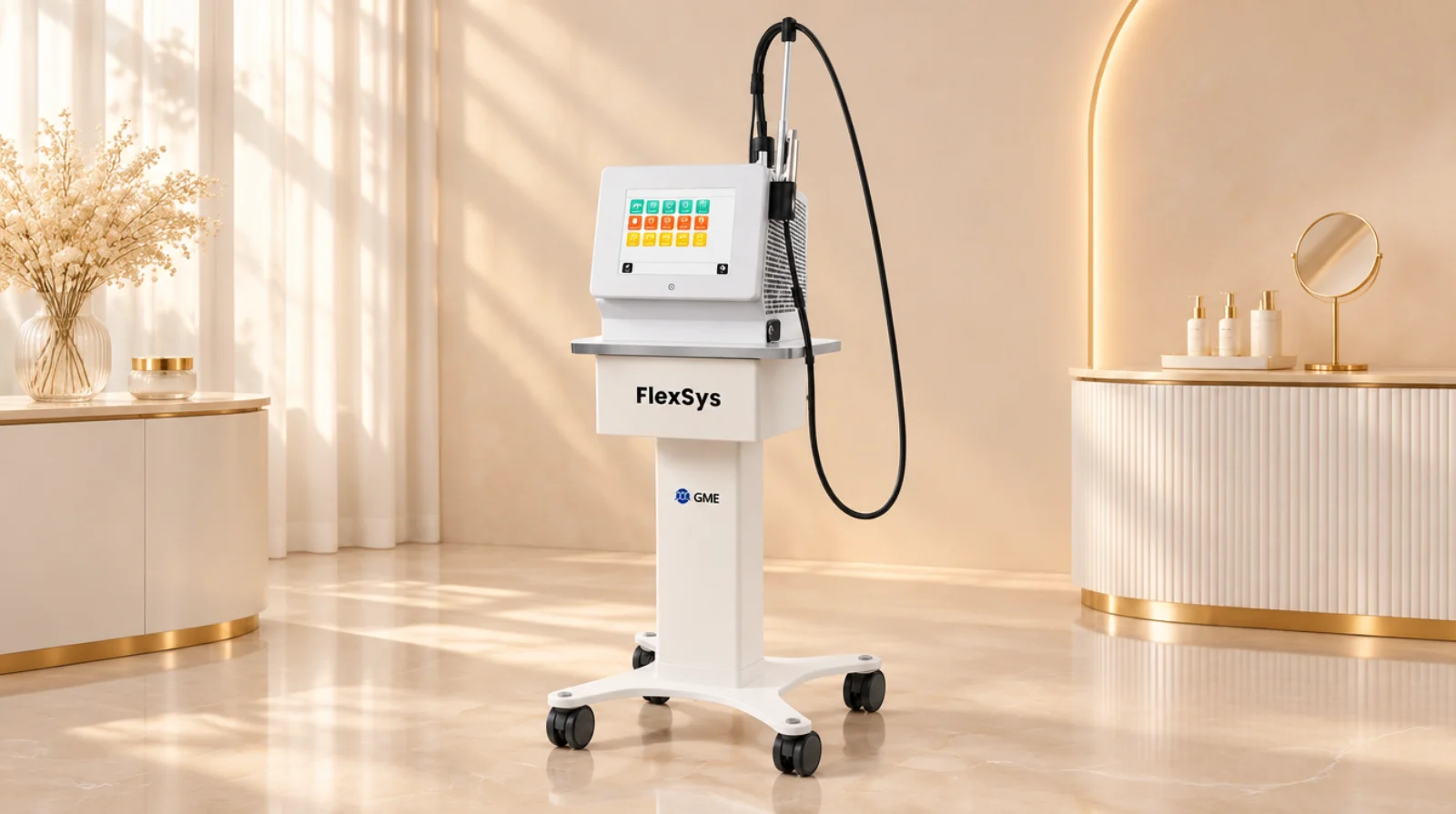
The 577 nm yellow laser has become one of the most discussed wavelengths in aesthetic dermatology, mainly because it sits on an absorption peak of oxyhaemoglobin. FlexSys by GME (Germany) brings a 577 nm yellow laser together with a 308 nm excimer, a 532 nm green laser and a 1550 nm non-ablative fractional laser on one modular base station. This article reviews the physics behind each wavelength, what the published clinical studies actually show, and the practical points clinicians should weigh before treating — especially in the darker skin types common in the Gulf.
Why one platform with several wavelengths
FlexSys is built around a single base station (30 × 30 × 30 cm, 15 kg) that accepts up to five modules. Each laser module uses a handy scanner, and a handpiece is available for the green and yellow modules. The touchscreen suggests treatment parameters based on clinical data, which the physician then adjusts. The modules are:
- Yellow laser, 577 nm — vascular lesions and pigment.
- Green laser, 532 nm — vascular treatments, depigmentation and ablative treatments.
- UVB EPL® 308 nm (excimer) and UVB EPL® lite 308 nm (LED) — psoriasis, vitiligo and aesthetic indications such as striae.
- Fractional non-ablative, 1550 nm — scars, wrinkles and pigmented variations such as lentigines, through controlled tissue heating that stimulates new collagen.
Clinically, the value of a modular platform is that each indication can be matched to the chromophore it needs, rather than stretching a single wavelength across conditions it was not designed for.
The physics: why 577 nm targets blood vessels
Lasers treat vascular lesions through selective photothermolysis: light is chosen to be absorbed by a target chromophore — here, haemoglobin — more than by the surrounding tissue. Haemoglobin shows absorption peaks in the blue, green and yellow bands at 418, 542 and 577 nm, and laser systems used for vascular lesions emit wavelengths near these peaks. Melanin competes more strongly at the shorter wavelengths (Wall, Semin Plast Surg 2007). This is the rationale for the yellow band: at 577 nm, absorption by oxyhaemoglobin is high, while competition from epidermal melanin is lower than at 532 nm. The 570–595 nm range has long been the standard band for vascular treatment.
What the studies show for 577 nm
Facial telangiectasia and spider angioma
In a pilot study of 41 patients with facial telangiectasia (37) or spider angioma (4) treated with a single session of a 577 nm laser, treatment was generally well tolerated with minimal pain, and most patients reached good, very good or complete recovery at one month (Lasers Med Sci 2021;36:401–406).
Erythematotelangiectatic rosacea and facial erythema
A case series of 40 patients with erythematotelangiectatic rosacea, facial erythema and facial telangiectasia, treated at 4-week intervals, concluded that the 577 nm laser was effective, safe and well tolerated for all three conditions (Kapicioglu et al., Lasers Med Sci 2019;34:93–98). A larger retrospective study of 98 patients with vascular disorders reported improvement rates of 74.8% in erythematotelangiectatic rosacea, 72% in facial erythema with telangiectasia and 68.3% in facial erythema alone (Ataseven et al., Eur J Ther). A prospective study of 95 patients also reported successful treatment across port-wine stains, papulopustular rosacea and facial telangiectasia (Mohamed et al., J Cosmet Dermatol 2019;18:1675–1679).
Melasma — as an adjunct
The yellow wavelength has also been studied in melasma, where a vascular component is now recognised. In a prospective split-face study of 82 patients, all received sunscreen and 4% hydroquinone on both sides, and one side also received a single pass of 577 nm laser monthly for three sessions. At six months, the MASI score on the laser-treated side was significantly lower than on the untreated side (Mohamed et al., J Cosmet Laser Ther 2020). The design matters: the laser was added to topical therapy, not used on its own.
308 nm excimer: targeted phototherapy for vitiligo and psoriasis
The 308 nm excimer delivers UVB to the lesion only, sparing surrounding skin. It is an option for localised vitiligo and for localised psoriasis that has not responded to topical treatment, and it can reach areas that are difficult with conventional phototherapy (DermNet). A systematic review and meta-analysis found no significant difference in efficacy between the excimer lamp and the excimer laser for ≥50% and ≥75% repigmentation in vitiligo, and concluded that excimer lamps, excimer laser and narrowband UVB are all safe and effective; adverse effects were mild — pruritus, burning and dryness (Am J Clin Dermatol 2016;17:23–32). Narrowband UVB remains first line for generalised vitiligo, while the excimer is better suited to localised disease. Combination with topical agents is common in practice and has been studied in meta-analyses of randomised trials.
532 nm green laser
The 532 nm wavelength sits close to the 542 nm haemoglobin peak and is also strongly absorbed by melanin, which explains its dual use for superficial vessels and epidermal pigment. In a randomised, double-blinded split-face trial comparing 532 nm KTP with a 585 nm yellow laser for cheek telangiectasia, outcomes were similar, while the yellow laser allowed faster treatment but was somewhat more painful (Tampere University, 2019). Because melanin absorbs 532 nm strongly, epidermal protection and conservative settings matter more in darker skin.
1550 nm non-ablative fractional laser
Non-ablative fractional lasers create columns of thermal injury while leaving the stratum corneum intact. In a histological review, 1550 nm lasers reached a mean depth of about 679 µm, compared with 895 µm for 10,600 nm and 837 µm for 2940 nm (Sardana et al., 2012). An evidence-based review of fractional lasers in skin of colour found Level 1 evidence for acne, striae and skin rejuvenation, and Level 2 evidence for acne scars, melasma and surgical or traumatic scars (J Clin Aesthet Dermatol 2017). In skin types IV–VI, non-ablative fractional lasers are often considered first line for acne scars because of their better safety profile, though they are less efficacious and need more sessions than ablative lasers (review of energy-based devices for acne scars in skin of colour).
Safety considerations in Gulf skin types
- Post-inflammatory hyperpigmentation (PIH) is the most common adverse event in Fitzpatrick IV–VI. A meta-analysis of non-ablative lasers and energy-based devices in these skin types found a pooled PIH rate of 8.1% and prolonged erythema of 0.6% (Aesthet Surg J 2022;42:537–547).
- For pigment work with 532 nm and for melasma, conservative fluences, test spots, strict photoprotection and topical maintenance are standard practice.
- For 308 nm phototherapy, the usual UV precautions apply, including screening for photosensitising medication and photosensitive conditions.
- Melasma and rosacea are chronic and relapsing; patients should be counselled that maintenance is part of the plan.
Key takeaways
- 577 nm matches an oxyhaemoglobin absorption peak, which is why it is well suited to telangiectasia, facial erythema and rosacea.
- Published 577 nm studies are positive but mostly small and non-randomised.
- 308 nm excimer has meta-analytic support for localised vitiligo, with efficacy comparable to narrowband UVB.
- 1550 nm non-ablative fractional resurfacing offers a lower-risk route for scars and texture in darker skin, at the cost of more sessions.
- One modular platform lets the clinic match wavelength to indication.
FlexSys for clinics in the UAE and Saudi Arabia
Bionics Medical supplies FlexSys to dermatology and aesthetic clinics in the UAE and Saudi Arabia, with installation, hands-on clinical training and after-sales support from our offices in Dubai, Riyadh and Abha.
View FlexSys specifications → | Request a demo
References
[1] Wall TL. Current concepts: laser treatment of adult vascular lesions. Semin Plast Surg. 2007;21(3):147–158. PMC2884838
[2] The efficacy of a single-session pro-yellow laser in the treatment of facial telangiectasia. Lasers Med Sci. 2021;36(2):401–406. PubMed 32592131
[3] Kapicioglu Y, Sarac G, Cenk H. Treatment of erythematotelangiectatic rosacea, facial erythema, and facial telangiectasia with a 577-nm pro-yellow laser: a case series. Lasers Med Sci. 2019;34(1):93–98.
[4] Ataseven A, Temiz SA, Özer I. An investigation of the effectiveness of the 577-nm pro-yellow laser in patients with vascular disorders. Eur J Ther. doi:10.58600/eurjther-346
[5] Mohamed EM, Mohamed Tawfik K, Hassan Ahmad W. Successful treatment of facial vascular skin diseases with a 577-nm pro-yellow laser. J Cosmet Dermatol. 2019;18(6):1675–1679.
[6] Mohamed EM, Younes AKH, Hussein GM. Efficacy of 577 nm pro-yellow laser in the treatment of melasma: a prospective split-face study. J Cosmet Laser Ther. 2020. doi:10.1080/14764172.2020.1744661
[7] Efficacy and safety of 308-nm monochromatic excimer lamp versus other phototherapy devices for vitiligo: a systematic review with meta-analysis. Am J Clin Dermatol. 2016;17(1):23–32. PubMed 26520641
[8] Sardana K, et al. Histological validity and clinical evidence for use of fractional lasers for acne scars. 2012. PMC3461801
[9] Nonablative fractional laser resurfacing in skin of color: evidence-based review. J Clin Aesthet Dermatol. 2017;10(6):51–67. PMC5605208
[10] Energy-based devices in the treatment of acne scars in skin of color. PubMed 36575886
[11] Adverse events of nonablative lasers and energy-based therapies in subjects with Fitzpatrick skin phototypes IV to VI: a systematic review and meta-analysis. Aesthet Surg J. 2022;42(5):537–547. PubMed 35019139
This article is intended for healthcare professionals and is for educational purposes only. It is not medical advice. Treatment decisions, parameters and indications should follow the manufacturer’s instructions for use, local regulatory approvals and the treating physician’s clinical judgement.