Erbium Glass 1550 nm and the 577 nm Yellow Laser: The Evidence for Combining Vascular and Fractional Treatment

Many of the problems patients bring to an aesthetic clinic have two components at once: a colour problem — redness from dilated vessels — and a structure problem — texture, thickness or depressed scarring. Acne scars with persistent redness, red surgical scars, burn scars and early striae are classic examples. No single wavelength handles both well. This article reviews the 1550 nm erbium glass fractional laser in depth, and then looks at what the evidence says about combining it with a vascular wavelength in the yellow band, such as 577 nm.
Part 1 — The 1550 nm erbium glass fractional laser
How it works
The 1550 nm wavelength is emitted by erbium-doped glass and erbium-doped fibre lasers. It targets water, creating a dense array of microscopic, columnar thermal zones that do not perforate or impair the function of the epidermis. The remodelling that follows can treat epidermal pigmentation, melasma and rhytides, as well as acne-related and surgical scars, with limited downtime (Skin Therapy Lett 2006). Because the stratum corneum stays intact, it is classed as non-ablative fractional resurfacing (NAFR). In a histological review, 1550 nm reached a mean depth of about 679 µm, compared with 895 µm for 10,600 nm CO2 and 837 µm for 2940 nm Er:YAG (Sardana et al., 2012).
Evidence by indication
- Consensus guidance: recommendations from experienced physicians on the erbium-doped 1550 nm laser covered dyschromia, rhytides, acne scars, surgical scars, melasma and striae, and concluded that optimal parameters depend on skin type and condition (Sherling et al., consensus recommendations).
- Surgical scars: in a randomised, blinded split-scar study of 15 scars, 1550 nm NAFL produced greater improvement than the 595 nm pulsed dye laser after four treatments at two-week intervals — mean 75.6% versus 53.9% (p<.001).
- Acne scars: in a randomised split-face trial, the Nd:YAG picosecond laser and the 1550 nm erbium fibre laser reduced ECCA scores by 38.89% and 33.33% respectively (Practical Dermatology review). A retrospective analysis of 31 patients found that 1550 nm treatment of atrophic acne scars was more effective in younger patients and in those taking isotretinoin concurrently (Dermatol Ther (Heidelb)).
- Trade-off versus ablative lasers: a series of non-ablative treatments is needed to achieve results comparable to a single ablative fractional treatment (Dermatology Times).
- Skin of colour: an evidence-based review found Level 1 evidence for fractional lasers in acne, striae and skin rejuvenation, and Level 2 evidence for acne scars, melasma and surgical or traumatic scars (J Clin Aesthet Dermatol 2017). A 2026 review of a dual 1550/1927 nm system in Fitzpatrick III–VI reported improvement in scarring, melasma and photoageing, linked lower pulse energy and density to reduced PIH risk, and called for more data in type VI (Lasers Surg Med).
- Becker’s naevus: in the largest case series to date, 1550 nm NAFR combined with laser hair removal was safe and effective in skin types III–VI (Lasers Surg Med 2023).
Safety in darker skin
PIH is the most common adverse event. A meta-analysis of non-ablative lasers and energy-based devices in Fitzpatrick IV–VI found a pooled PIH rate of 8.1% and prolonged erythema of 0.6% (Aesthet Surg J 2022). Lower density, conservative energy and strict photoprotection are the main levers.
Part 2 — Why combine a yellow vascular laser with 1550 nm?
The rationale is complementary targets. A vascular laser treats scar hypervascularity, while 1550 nm erbium glass stimulates collagen remodelling (Tao et al., 2018). Acne erythema is now considered an early scar with erythematous components rather than a simple vascular lesion (Zhou et al., 2024). The yellow band — 577 nm, and the 585/595 nm pulsed dye laser — sits on the oxyhaemoglobin absorption peak, which is why it is used for erythema.
Evidence for 577 nm in post-acne redness and scars
- In 40 patients treated with a single 577 nm session at 22 J/cm², 52.5% had good and 25% excellent improvement of post-acne erythema; the effect on atrophic acne scars was mild to moderate (Sarac et al., Dermatol Ther 2021). The authors also reported that the laser could be used safely immediately after stopping systemic isotretinoin.
- In a comparative study of 60 patients, both topical brimonidine 0.33% and the 577 nm laser (four sessions) were effective for post-acne erythema, but the laser was superior (J Clin Aesthet Dermatol 2025;18:35–39).
This pattern — strong on redness, modest on scar depth — is exactly why a fractional partner makes sense.
What the combination studies show
- Surgical scars — randomised controlled trial: adults after skin surgery were randomised to three sessions of combined PDL and NAFL every 2–8 weeks, or no treatment. Of 76 participants, 52 completed the study, and no severe adverse events were reported (Kang et al., Ann Surg 2022;276:975–980). Scar thickness, stiffness and erythema improved.
- Erythematous acne scars — randomised study: 90 patients with acne vulgaris were randomised to two groups. The group receiving 595 nm PDL plus 1565 nm NAFL showed a more pronounced reduction in erythema areas and a significantly higher erythema regression rate (Zhou et al., J Cosmet Dermatol 2024).
- Burn scars in Fitzpatrick III: two patients treated with PDL plus 1550 nm erbium glass and 1927 nm thulium improved significantly in thickness, texture and colour. The authors noted the combination is particularly advantageous in patients at higher risk of post-procedure hyperpigmentation (Tao et al., Scars Burns Heal 2018).
- Vascular laser with ablative lasers: a meta-analysis of randomised trials found ablative laser combined with PDL more effective and safer than either alone for pathological scars (Tian et al.).
- Yellow light after fractional resurfacing: a prospective, evaluator-blinded split-face trial in 36 adults with acne scars is comparing an immediate sub-purpuric 595 nm PDL pass with a 577 nm yellow laser pass to shorten post-CO2 erythema, which prolongs downtime and may increase PIH risk (IMCAS presentation). This is an emerging area.
Practical sequencing
Expert guidance for red scars is that vascular devices are the first choice, and when several lasers are used in one session, the vascular laser goes first, followed by a resurfacing laser if needed (Green, reported in The Hospitalist). In darker skin, conservative 1550 nm density and energy remain the main safeguards against PIH.
Key takeaways
- 1550 nm erbium glass is a non-ablative fractional laser with supporting evidence for acne and surgical scars, striae, melasma and photoageing, and a favourable safety profile in darker skin.
- 577 nm is highly effective for post-acne erythema but has a modest effect on atrophic scar depth.
- Randomised data support combining a yellow-band vascular laser with a non-ablative fractional laser for surgical and erythematous acne scars.
- Direct 577 nm + 1550 nm studies are not yet published; current protocols extrapolate from pulsed dye laser data.
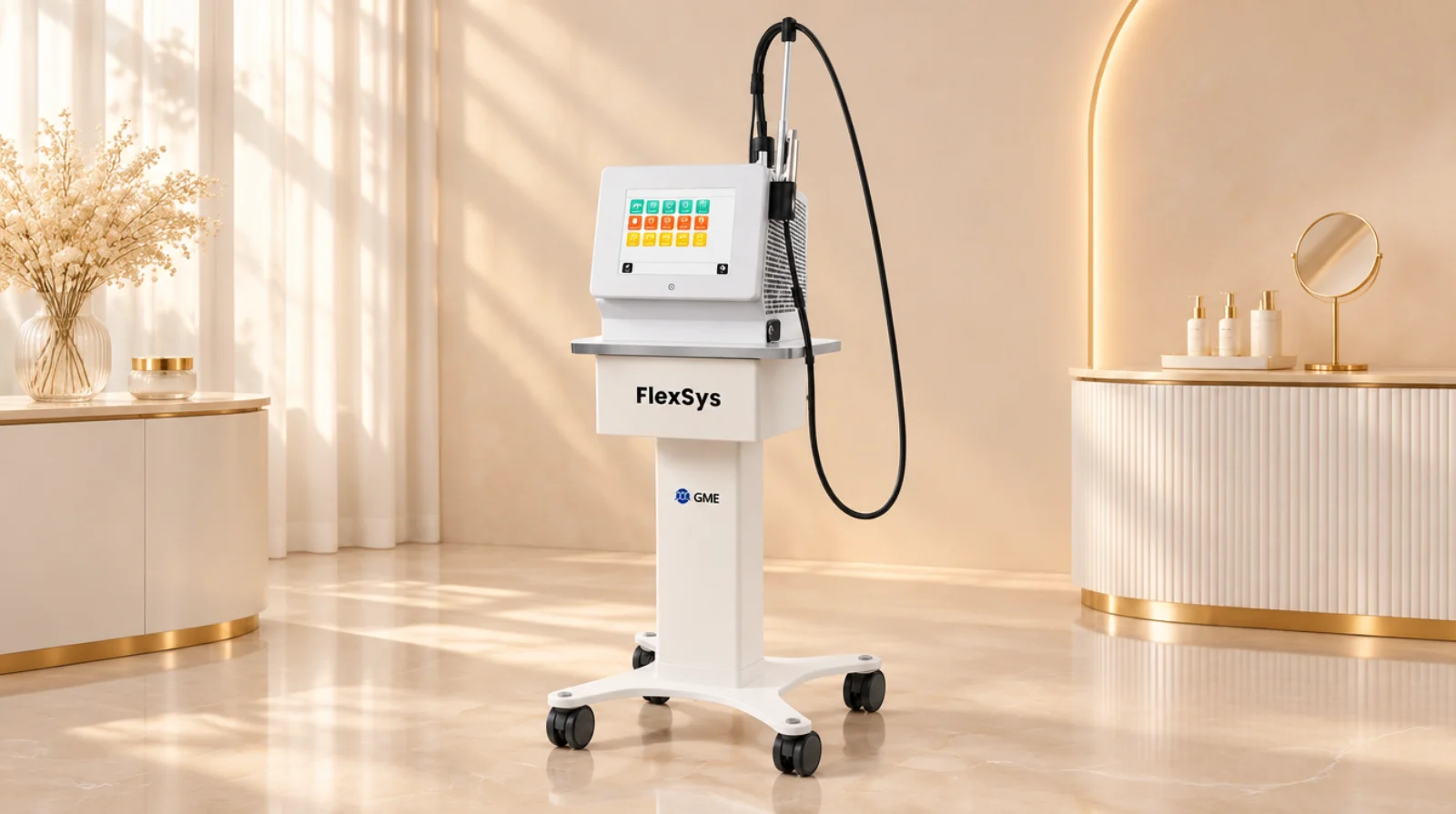
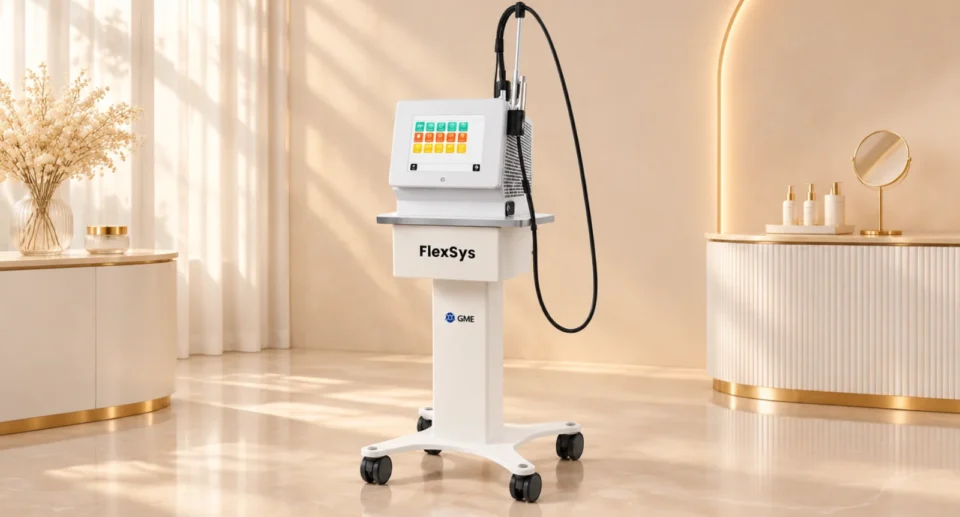
- FlexSys houses both a 577 nm yellow module and a 1550 nm fractional module on one base station.
FlexSys for clinics in the UAE and Saudi Arabia
Bionics Medical supplies FlexSys to dermatology and aesthetic clinics in the UAE and Saudi Arabia, with installation, hands-on clinical training and after-sales support from our offices in Dubai, Riyadh and Abha.
View FlexSys specifications → | Request a demo
References
[1] Fractional laser treatment for pigmentation and texture improvement. Skin Therapy Lett. 2006;11(9):7–11. PubMed 17075654
[2] Sardana K, et al. Histological validity and clinical evidence for use of fractional lasers for acne scars. 2012. PMC3461801
[3] Sherling M, Friedman PM, Adrian R, Burns AJ, et al. Consensus recommendations on the use of an erbium-doped 1,550-nm fractionated laser and its applications in dermatologic laser surgery.
[4] Nonablative fractional laser versus pulsed dye laser for surgical scars: a randomized blinded split-scar study. PubMed 19250300
[5] Laser therapy for atrophic acne scars: a case and evidence-based updates. Practical Dermatology.
[6] Clinical factors affecting the effect of non-ablative fractional laser for individual atrophic acne scar types. Dermatol Ther (Heidelb). doi:10.1007/s13555-022-00887-8
[7] Nonablative fractional laser resurfacing in skin of color: evidence-based review. J Clin Aesthet Dermatol. 2017;10(6):51–67. PMC5605208
[8] Dual 1550/1927-nm laser system in Fitzpatrick skin types III–VI: review. Lasers Surg Med. 2026 (reported by Modern Aesthetics).
[9] Combination 1550 nm non-ablative fractional resurfacing and laser hair removal for treatment of Becker’s nevi in skin types III–VI. Lasers Surg Med. 2023;55(1):99–104. PubMed 36129813
[10] Adverse events of nonablative lasers and energy-based therapies in subjects with Fitzpatrick skin phototypes IV to VI: a systematic review and meta-analysis. Aesthet Surg J. 2022;42(5):537–547. PubMed 35019139
[11] Tao J, Champlain A, Weddington C, Moy L, Tung R. Treatment of burn scars in Fitzpatrick phototype III patients with a combination of pulsed dye laser and non-ablative fractional resurfacing 1550 nm erbium:glass/1927 nm thulium laser devices. Scars Burns Heal. 2018. PMC5965338
[12] Zhou C, et al. Treatment of erythematous acne scars using 595-nm pulsed dye laser combined with 1565-nm nonablative fractional laser. J Cosmet Dermatol. 2024. doi:10.1111/jocd.16235
[13] Sarac G, Kapicioglu Y, Cenk H. An evaluation of the efficacy of a single-session 577 nm pro-yellow laser treatment in patients with postacne erythema and scarring. Dermatol Ther. 2021;34(1). doi:10.1111/dth.14611
[14] Topical brimonidine tartrate 0.33% gel versus 577-nm pro-yellow laser for treatment of post acne erythema: a comparative study. J Clin Aesthet Dermatol. 2025;18(1):35–39.
[15] Kang BY, Ibrahim SA, Weil A, et al. Treatment of surgical scars with combination pulsed dye and fractional nonablative laser: a randomized controlled trial. Ann Surg. 2022;276(6):975–980. doi:10.1097/SLA.0000000000005377
[16] Tian Y, Li M, Cheng R, Yuan J, Hao L. Clinical efficacy of ablative laser combined with pulsed dye laser in the treatment of pathological scars: a systematic review and meta-analysis. PMC10828520
[17] Post-fractional CO2 erythema resolution: comparative efficacy of early sub-purpuric versus delayed standard 595-nm PDL and 577-nm laser therapy. IMCAS presentation.
[18] Energy-based devices: expert shares treatment tips for rosacea and scars. The Hospitalist.
This article is intended for healthcare professionals and is for educational purposes only. It is not medical advice. Treatment decisions, parameters and indications should follow the manufacturer’s instructions for use, local regulatory approvals and the treating physician’s clinical judgement.