
Exosomes in Aesthetic Dermatology: A 2026 Evidence Review for Clinicians


Few topics in aesthetic medicine have grown as quickly as exosomes. They appear in conference programmes, product launches and patient questions almost everywhere. The science behind them is genuinely exciting, but the clinical evidence is still young, and the products sold under the word “exosome” differ widely in source, preparation and regulation. This review sets out what the peer-reviewed literature actually says in 2026, where the gaps are, and why the source of an exosome preparation matters — with MyExo, an autologous point-of-care system, as a worked example.
What exosomes are
Exosomes are small extracellular vesicles, roughly 30–150 nm, released by almost every cell type. They carry proteins, mRNA and microRNA between cells and influence how recipient cells behave. In skin and hair research, vesicles from platelets, mesenchymal stem cells and other sources have been studied for effects on fibroblasts, collagen synthesis, inflammation, macrophage polarisation and angiogenesis. Their small size and natural role in cell-to-cell signalling are the reason they are also studied as biomarkers and drug-delivery vehicles.
What the literature says in 2026
Several reviews published between 2024 and 2026 reach a consistent conclusion: the biological rationale is strong, and early clinical results are encouraging, but high-quality trials are scarce.
- Comprehensive dermatology review (2025): exosomes have shown clinical efficacy in skin ageing, scarring, hair restoration and melasma, and proper characterisation of exosome cargo is necessary to ensure safety and efficacy (Int J Dermatol 2025;64:1995–2010).
- Review for the practising dermatologist (2025): exosomes have shown promise in preclinical models for anti-ageing, anti-inflammatory use, wound healing, scar reduction and hair regeneration. However, clinical studies are lacking, and there are substantial safety concerns, such as potential risk of infection, unwanted inflammatory response and promotion of malignancy (Mahmoud et al., J Clin Aesthet Dermatol 2025;18:33–40).
- Cosmetic dermatology review (2024): of 34 studies, the authors concluded that clinical use is held back by cost, complex isolation, lack of uniform protocols and limited assessment of infection risk (Skin Health Dis 2024).
- Hair loss review (2025): 48 studies were identified, 25 of them clinical trials, but very limited data exist on safety and efficacy in humans, and the authors called for regulatory oversight (Dermatol Surg 2025;51:409–415).
- Scoping review (2026): safety remains undefined despite commercial availability, and interpretation is limited by non-randomised, single-arm designs and potential conflicts of interest (J Drugs Dermatol 2026;25:368–376).
- Skin lightening and rejuvenation (2025): a systematic review of 19 studies with 624 patients found that only 21% investigated extracellular vesicles, while 78% studied conditioned media — a reminder that many “exosome” claims rest on different products.
Why the source matters
“Exosome” is used as a single word for very different products. The main categories are:
- Autologous — prepared from the patient’s own blood at the point of care, used fresh under physician control.
- Allogeneic human — derived from donor cells and manufactured under laboratory controls; use depends on product authorisation.
- Animal-derived — non-human source, off-the-shelf; often positioned as cosmetic or topical.
- Plant-derived — exosome-like cosmetic vesicles that are not interchangeable with human extracellular vesicles.
Source affects the questions a clinician must ask: donor screening and infection risk for allogeneic products; immunogenicity for non-human material; and, for every category, how the vesicles were characterised. Regulation also varies by jurisdiction and by product category.
How MyExo is prepared and characterised
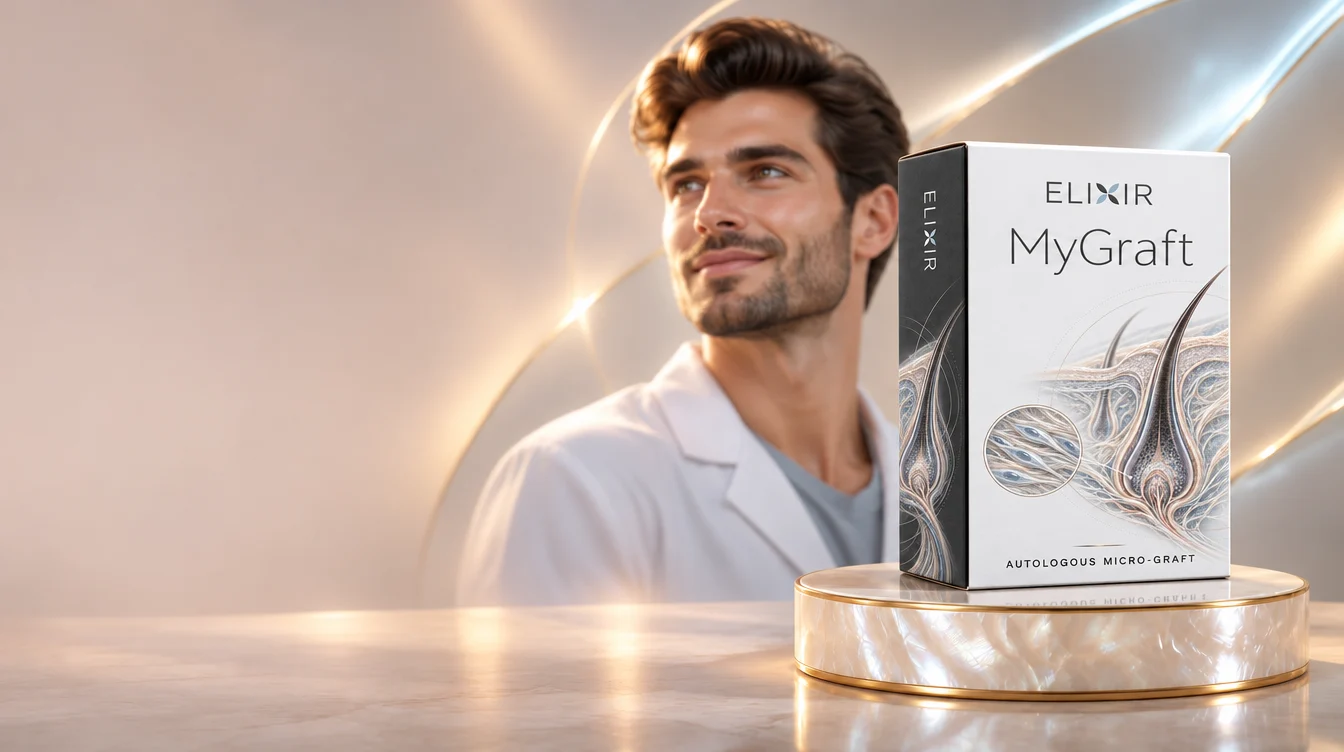
MyExo (Elixir, by t-lab, built on the Exomine platform) is an autologous exosome-rich plasma prepared from the patient’s own blood in a closed system in about 30 minutes. According to the manufacturer:
- 40 mL of blood is drawn into a PRX tube, whose internal vertical lines create a vortex during centrifugation.
- The plasma is passed through the Microlyzer (over 3,500 blades, 600 µm design), which stretches the platelet membrane without destroying platelets, then centrifuged sequentially in the Advanced Exosome Tube.
- No additives or chemicals are used. Final volume is 10 mL.
- Reported characterisation: about 12 trillion exosomes in 10 mL; mean size 120 nm (±15); range about 30–150 nm; recovery ≥89%; 5.5–6× concentration versus starting plasma; characterisation following MISEV2023 recommendations, with flow cytometry markers CD9 99.6%, CD81 98.5%, CD61 98.6%, CD41 99.4% and CD45 0.3%.
- The system is CE certified and ISO 13485:2016 certified.
Two points deserve emphasis. First, these figures are the manufacturer’s data from its own characterisation; independent replication is how the field builds confidence. Second, the reviews above repeatedly name standardised characterisation as a key gap — so it is reasonable for clinicians to ask any exosome supplier for size distribution, particle counts and marker data.
Clinical data on the Exomine platform
The first peer-reviewed clinical study on the Exomine kit is a retrospective review of 60 women treated for sexual function, with three sessions four weeks apart and follow-up to 12 months using the Female Sexual Function Index. Scores improved significantly in all four treatment groups at 6 and 12 months; side effects were minor (itching, redness, mild pain). The particles in that study had a mean size of 111.6 nm and 98.9% viability. The author calls for larger randomised trials (Aglamis, Aesthet Surg J 2025;45:922–927). As a single-centre retrospective study, it is a starting point rather than definitive proof.
Practical guidance for clinics
- Present exosome treatment as an emerging, evidence-building option, and avoid promises of specific outcomes.
- Prefer products with transparent characterisation data (particle count, size distribution, markers) and a clear regulatory status for the intended route of use.
- Follow aseptic technique strictly — infection is one of the named risks in the literature.
- Document outcomes with standardised photography and validated scales; real-world data from clinics are part of how the field will mature.
Key takeaways
- The biology of exosomes is compelling, and early clinical results in skin, scars and hair are encouraging.
- Most reviews agree that randomised controlled trials, standardised protocols and long-term safety data are still lacking.
- The source — autologous, allogeneic, animal or plant — changes both the risk questions and the regulatory pathway.
- MyExo is an autologous, closed-system, point-of-care option with published manufacturer characterisation and a first peer-reviewed retrospective study.
MyExo for clinics in the UAE and Saudi Arabia
Bionics Medical supplies Elixir MyExo to clinics in the UAE and Saudi Arabia, with training on preparation and clinical protocols from our offices in Dubai, Riyadh and Abha.
Learn more about MyExo → | Request a demo
References
[1] Exosomes in dermatology: a comprehensive review of current applications, clinical evidence, and future directions. Int J Dermatol. 2025;64(11):1995–2010. PubMed 40533901
[2] Mahmoud RH, Peterson E, Badiavas EV, Kaminer M, Eber AE. Exosomes: a comprehensive review for the practicing dermatologist. J Clin Aesthet Dermatol. 2025;18(4):33–40. PMC12007658
[3] Clinical applications of exosomes in cosmetic dermatology. Skin Health Dis. 2024;4(6):e348. PMC11608875
[4] Exosomes for treating hair loss: a review of clinical studies. Dermatol Surg. 2025;51(4):409–415. PubMed 39447204
[5] Exosome-based therapies in dermatology: a scoping review. J Drugs Dermatol. 2026;25(4):368–376. PubMed 41931695
[6] Effectiveness of regenerative medicine for skin lightening and rejuvenation: a systematic review of extracellular vesicles and conditioned media. PMC12465346
[7] Exosomes in the real world of medical aesthetics: a review. Aesthetic Plast Surg. 2024. doi:10.1007/s00266-023-03844-8
[8] Aglamis SO. Aesthet Surg J. 2025;45(9):922–927. doi:10.1093/asj/sjaf104
This article is intended for healthcare professionals and is for educational purposes only. It is not medical advice. Product data are as stated by the manufacturer. Use should follow the manufacturer’s instructions, local regulatory requirements and the treating physician’s clinical judgement.