
Q-Switched Nd:YAG Laser: Tattoos, Naevus of Ota and Melasma Toning — An Evidence Review

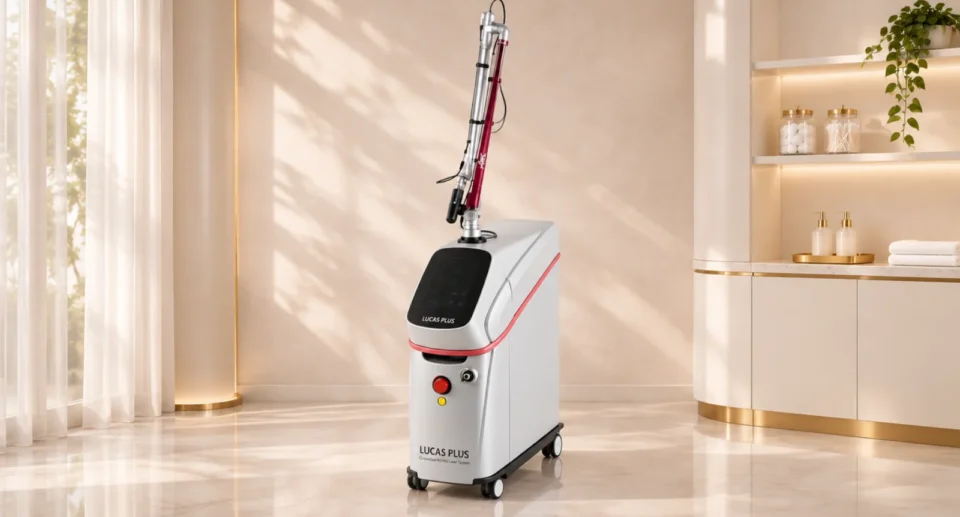
Q-switched Nd:YAG lasers are the workhorse of pigment and tattoo treatment, and low-fluence “laser toning” has become one of the most popular melasma procedures in Asia and the Middle East. Lucas Plus by AMT Engineering is a high-power Q-switched Nd:YAG platform with 1064 nm and 532 nm wavelengths and several pulse modes. This article explains the science of nanosecond pigment lasers, reviews the clinical evidence for tattoos, naevus of Ota and melasma, and sets out the safety issues — including recurrence and mottled hypopigmentation — that every clinic should discuss with patients.
Selective photothermolysis in nanoseconds
Pigment particles — melanosomes or tattoo ink — are tiny, so they cool down extremely fast. To destroy them without heating the surrounding skin, energy must be delivered in a pulse shorter than their thermal relaxation time. Q-switching produces pulses in the nanosecond range, generating a photomechanical (photoacoustic) effect that fragments pigment, which is then cleared by macrophages. The two wavelengths have different jobs: 1064 nm penetrates deeper and is less absorbed by epidermal melanin, so it suits dermal pigment and darker skin; 532 nm is strongly absorbed by melanin and suits superficial, epidermal lesions.
Lucas Plus modes and handpieces
- Q-switched mode (5–10 ns) — tattoos, naevus of Ota and epidermal pigment.
- S mode (100 ns toning pulse) — designed for melasma and pigmented lesions.
- PTP dual-pulse mode — splits each pulse in two; the manufacturer states this reduces pain, injury and pigment side effects.
- G-mode, free-running (300 µs) — skin tightening, rejuvenation and pore reduction through gentle dermal heating.
- Handpieces: Zoom (2–10 mm, 1 mm steps), Fractional (81 points, 5 × 5) and MLA micro-lens array.
- Top-hat beam profile, auto-detected spot sizes, 1–15 Hz, and maximum energy of 1200 mJ at 1064 nm, 1600 mJ in PTP mode, 300 mJ at 532 nm and 3000 mJ in G-mode.
Tattoo removal: what the studies show
Q-switched 1064/532 nm Nd:YAG is considered a gold-standard device for tattoo removal. In one clinical series, the mean number of sessions was 4.6 ± 2.5, and a removal rate of 60% or higher was achieved (PMC8304052). Traditional single-pass protocols can require many sessions — up to 20 in some reports — and an average of 7–10 is often quoted (PMC4411606). The Kirby–Desai scale, which scores skin type, location, colour, ink amount, scarring and layering, helps estimate the number of sessions within about ±2.5.
Newer multi-pass techniques aim to shorten this. A 2024 retrospective evaluation of a short-pulsed dual-wavelength Q-switched Nd:YAG found the actual number of treatments was significantly lower than the Kirby–Desai prediction — an average of 5.09 versus 9.9 — with no severe adverse events (J Cosmet Dermatol 2024). A study of the R0 technique in skin types IV–VI also reported faster clearance. Intervals between sessions are typically long; one series used a minimum of two months on the upper body and three to four months on the lower limbs (Marini et al., Lasers Med Sci 2022).
Naevus of Ota
Dermal melanocytosis such as naevus of Ota is a classic 1064 nm indication. In a retrospective analysis of 160 children, age at first treatment, lesion colour and number of treatments were associated with efficacy, and Q-switched Nd:YAG and alexandrite lasers were compared for efficacy, safety and recurrence (Lasers Med Sci 2023;38:64). The manufacturer’s suggested protocol for Ota naevus is every 4 weeks for 3–10 sessions.
Melasma and laser toning: promise and limits
Laser toning uses a large spot, low fluence and multiple passes of Q-switched 1064 nm. The concept dates back to 1999, and the low-fluence Q-switched Nd:YAG is now the most commonly used laser for melasma (PMC6676813). The proposed mechanism is subcellular selective photothermolysis — damaging melanosomes without killing melanocytes. Studies in Asian patients have shown benefit, for example 15 weekly sessions at 2.8 J/cm² with an 8 mm spot in 50 patients (J Dermatolog Treat 2014), and a split-face study found toning superior to the Q-switched ruby laser, with a longer recurrence-free interval (Omi et al.).
But the limits are real, and clinicians should present them honestly:
- Recurrence: a 2022 systematic review noted considerable recurrence three months after treatment and a lack of long-term follow-up data (Lee et al., Medicina 2022). Even when combined with IPL, “recurrence is still inevitable” (JEADV 2015).
- Mottled (confetti) hypopigmentation: in a series of 23 patients treated three times a week for two months, all developed bilateral confetti hypopigmentation — a reminder that aggressive frequency and cumulative dose carry risk.
- Laser toning works best as part of a combined plan with sunscreen and topical depigmenting therapy. The manufacturer suggests 1–2 week intervals and at least 10 sessions for melasma.
MLA handpiece and skin rejuvenation
Micro-lens arrays split the beam into highly focused micro-beams. At sufficient intensity, this can create laser-induced optical breakdown (LIOB) — tiny intradermal cavities that trigger new collagen, elastic tissue and mucin while the epidermis is largely spared. LIOB-based rejuvenation was first described with sub-nanosecond Nd:YAG pulses (Habbema et al., 2011–2012), and much of the current literature uses picosecond lasers. Clinicians should therefore set expectations for nanosecond MLA treatment from the device’s own clinical data rather than extrapolating picosecond results.
Key takeaways
- Q-switched Nd:YAG is a standard tool for tattoos (typically 4–10 sessions) and dermal pigment such as naevus of Ota.
- Laser toning can improve melasma, but recurrence is common and over-treatment can cause mottled hypopigmentation.
- Lucas Plus combines Q-switched, toning (S mode), PTP, G-mode and MLA/fractional delivery on one platform.
- Combination with topical therapy and strict photoprotection is essential for pigment disorders.
Lucas Plus for clinics in the UAE and Saudi Arabia
Bionics Medical supplies Lucas Plus to dermatology and aesthetic clinics in the UAE and Saudi Arabia, with installation, hands-on clinical training and after-sales support from our offices in Dubai, Riyadh and Abha.
View Lucas Plus specifications → | Request a demo
References
[1] Q-switched 1064/532 nm laser for tattoo removal — clinical experience. PMC8304052
[2] Laser tattoo removal: review of techniques and the Kirby–Desai scale. PMC4411606
[3] Retrospective clinical evaluation of Q-switched Nd:YAG laser safety and efficacy in tattoo removal: a new perspective on the Kirby–Desai scale. J Cosmet Dermatol. 2024;23(3):818–823. PubMed 38308455
[4] Aurangabadkar SJ, et al. A prospective open-labeled study of tattoo removal with Q-switched Nd:YAG laser utilizing the R0 technique and correlation with Kirby–Desai scale. J Cutan Aesthet Surg. 2019. PMC6676804
[5] Marini L, et al. Q-S laser micro-drilling and multipass full-beam Q-S laser for tattoo removal — a case series. Lasers Med Sci. 2022;37(3):1763–1771. PMC8971194
[6] Efficacy and safety of Q-switched lasers for the treatment of naevus of Ota in children: a retrospective analysis. Lasers Med Sci. 2023;38:64.
[7] Laser toning for melasma: a review. PMC6676813
[8] Treatment of melasma by low-fluence 1064 nm Q-switched Nd:YAG laser. J Dermatolog Treat. 2014;25(3):212–217. PubMed 23030603
[9] Omi T, et al. Low fluence Q-switched Nd:YAG laser toning and Q-switched ruby laser in the treatment of melasma: a comparative split-face ultrastructural study. Laser Ther. 2012;21(1). PMC3944591
[10] Lee YS, et al. The low-fluence Q-switched Nd:YAG laser treatment for melasma: a systematic review. Medicina. 2022;58(7):936. PMC9323185
[11] Low-fluence Q-switched Nd:YAG 1064-nm laser and intense pulsed light for the treatment of melasma. J Eur Acad Dermatol Venereol. 2015;29(7):1339–1346. PubMed 25413592
[12] Confetti hypopigmentation after low-fluence laser toning — retrospective analysis of 23 patients. PMC5605223
[13] Habbema L, et al. Minimally invasive non-thermal laser technology using laser-induced optical breakdown for skin rejuvenation. Lasers Med Sci. doi:10.1007/s10103-012-1179-z
This article is intended for healthcare professionals and is for educational purposes only. It is not medical advice. Treatment decisions, parameters and indications should follow the manufacturer’s instructions for use, local regulatory approvals and the treating physician’s clinical judgement.