


Radiofrequency Microneedling: How It Works, Insulated vs Non-Insulated Needles, and the Evidence

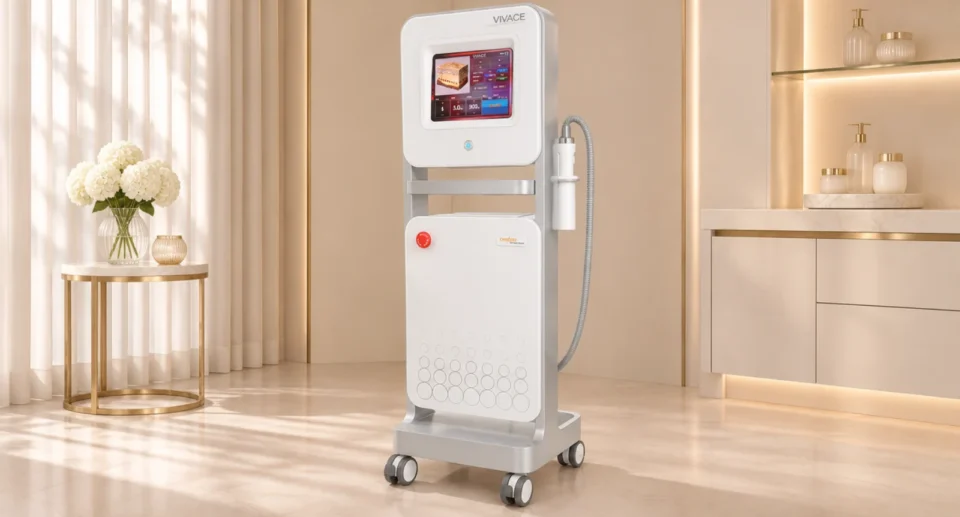
Radiofrequency microneedling (RFMN) has grown from a niche procedure into one of the most widely used treatments for acne scars, texture and skin laxity — largely because it delivers heat into the dermis while sparing most of the epidermis. That makes it especially relevant for darker skin types. Vivace is a microneedle RF device offering 1 MHz and 2 MHz frequencies, depth control from 0.5 to 3.5 mm and both insulated and non-insulated needles. This article explains how RFMN works, what the clinical studies show, and how needle type and depth change the treatment.
How radiofrequency microneedling works
Treatment happens in three steps: microneedles penetrate the skin, RF energy is emitted at the needle tips, and the body responds by producing new collagen and elastin. Vivace is described as a medical device that causes tissue coagulation using high-frequency current. Because the energy is released inside the dermis, RFMN produces controlled thermal zones at a chosen depth with limited epidermal injury. A 2014 review of RF modalities for acne scars concluded that microneedle bipolar RF and fractional bipolar RF offered the best results among RF approaches (Clin Cosmet Investig Dermatol 2014;7:335–339).
Vivace features that change the treatment
- Two frequencies, 1 MHz and 2 MHz, allowing different heating profiles.
- Depth from 0.5 to 3.5 mm in 0.1 mm steps, so treatment can be layered — superficial passes for texture and pores, deeper passes for scars and laxity.
- Insulated and non-insulated needles. Insulated needles release energy only at the tip, protecting the epidermis; non-insulated needles heat along the shaft, adding a more superficial effect.
- Selectable red or blue LED.
Listed indications are lifting, elasticity, inflammatory acne, acne scars, wrinkles (fine, deep and nasolabial folds), pores, skin regeneration and stretch marks.
Insulated or non-insulated?
Both needle types are effective. In a comparative study of facial indications presented at IMCAS 2025, insulated needles were superior to non-insulated needles only for rolling acne scars, with no significant difference for other scar types or other indications such as tightening and telangiectasia. The authors suggested non-insulated needles may be more cost-effective outside rolling scars. Non-insulated RFMN has also performed well in its own right: in a preliminary study of 19 patients, non-insulated fractional microneedle RF reduced depressed acne scars and pore size and improved texture with short downtime (Elawar & Dahan, J Clin Aesthet Dermatol 2018). A 2025 randomised split-face study compared non-insulated microneedle RF with ablative fractional CO2 for atrophic acne scarring, noting that CO2‘s substantial downtime limits its use (Acta Derm Venereol 2025).
Clinical evidence by indication
Atrophic acne scars
- In 30 Asian patients, at the 6-month follow-up the largest group (42.3%) reported a 26–50% improvement, and reduction in scar volume matched clinical evaluation, with minimal downtime (JEADV 2014;28:1219–1225).
- In a prospective study of 44 patients with skin types III–V, four sessions three weeks apart were effective. Erythema occurred in all patients, oedema in 12, and PIH in only two (PMC11619162).
Active acne
In a prospective trial of 25 patients with moderate to severe acne treated three times at monthly intervals, inflammatory and non-inflammatory lesions decreased, and sebum excretion and satisfaction improved compared with baseline (PubMed 24807263).
Rejuvenation and laxity
A critical review of higher-quality evidence concluded that RFMN is effective, can be repeated safely, combines well with other treatments, and is suitable for darker phototypes. It also stressed that dermal remodelling is slow and progressive, continuing to improve six months after treatment (Dermatol Surg 2021;47:755–761). This matters for counselling: results build over months, not days.
Melasma
RFMN is being studied for melasma because it targets dermal pathology while minimising epidermal injury, which can provoke PIH in types III–V. A 2025 systematic review in Aesthetic Surgery Journal Open Forum examined this use; it should still be regarded as an emerging indication.
Why RFMN suits darker skin
RF and RFMN are believed to carry a lower risk of dyspigmentation in darker skin types. A systematic review of 35 articles on RF and RFMN in Fitzpatrick III–VI explored this question (Dermatol Surg 2023;49:489–493). For context, a meta-analysis of non-ablative lasers and energy-based devices in types IV–VI found a pooled PIH rate of 8.1% (Aesthet Surg J 2022), and up to 92% of type IV+ patients may develop PIH after ablative CO2 (Hang & Lim 2025). This is why RFMN is often chosen first, or used in a staged plan, for scar and texture work in Gulf patients.
Practical safety points
- Expected effects: erythema and oedema for a few days, with pinpoint marks at needle sites.
- PIH remains possible, especially with non-insulated needles, high energy or stacking in darker skin; strict photoprotection is advised.
- Typical precautions: avoid active infection at the site, pregnancy, and implanted electronic devices such as pacemakers; take a history of keloid tendency, metal implants in the area and recent isotretinoin use.
Key takeaways
- RFMN delivers controlled dermal heating with limited epidermal injury, which makes it suitable for darker skin.
- Evidence supports its use for atrophic acne scars, active acne, texture and laxity; melasma is emerging.
- Insulated needles help most for rolling scars; non-insulated needles are effective for many other indications.
- Vivace offers 1 and 2 MHz, depth from 0.5 to 3.5 mm in 0.1 mm steps, and both needle types.
- Results build over months as collagen remodels.
Vivace for clinics in the UAE and Saudi Arabia
Bionics Medical supplies Vivace to dermatology and aesthetic clinics in the UAE and Saudi Arabia, with installation, hands-on clinical training and after-sales support from our offices in Dubai, Riyadh and Abha.
View Vivace specifications → | Request a demo
References
[1] Use of radiofrequency in cosmetic dermatology: focus on nonablative treatment of acne scars. Clin Cosmet Investig Dermatol. 2014;7:335–339. PubMed 25540589
[2] Comparison of insulated and non-insulated needles in microneedling radiofrequency. IMCAS World Congress 2025, session 55872.
[3] Elawar A, Dahan S. Non-insulated fractional microneedle radiofrequency treatment with smooth motor insertion for reduction of depressed acne scars, pore size, and skin texture improvement. J Clin Aesthet Dermatol. 2018;11(8):41–44. PMC6122511
[4] Qu L, Sha S, et al. Comparison of non-insulated microneedle fractional radiofrequency and ablative fractional CO2 laser for facial atrophic acne scarring: a pilot randomized split-face clinical study. Acta Derm Venereol. 2025. doi:10.2340/actadv.v105.43611
[5] The efficacy in treatment of facial atrophic acne scars in Asians with a fractional radiofrequency microneedle system. J Eur Acad Dermatol Venereol. 2014;28(9):1219–1225. PubMed 25158223
[6] Efficacy and safety of microneedling radiofrequency in the treatment of acne scars. PMC11619162
[7] Treatment of acne vulgaris with fractional radiofrequency microneedling. PubMed 24807263
[8] Radiofrequency microneedling: a comprehensive and critical review. Dermatol Surg. 2021;47(6):755–761. PubMed 33577211
[9] The efficacy and safety of radiofrequency microneedling for melasma: a systematic review and qualitative evidence synthesis. Aesthetic Surgery Journal Open Forum. 2025.
[10] Radiofrequency and radiofrequency microneedling in skin of color: a review of usage, safety, and efficacy. Dermatol Surg. 2023;49(5):489–493. PubMed 36826381
[11] Adverse events of nonablative lasers and energy-based therapies in subjects with Fitzpatrick skin phototypes IV to VI: a systematic review and meta-analysis. Aesthet Surg J. 2022;42(5):537–547. PubMed 35019139
[12] Hang X, Lim DS. A novel peel to prevent post-inflammatory hyperpigmentation after CO2 resurfacing for acne scars. J Cosmet Dermatol. 2025;24(8):e70366.
This article is intended for healthcare professionals and is for educational purposes only. It is not medical advice. Treatment decisions, parameters and indications should follow the manufacturer’s instructions for use, local regulatory approvals and the treating physician’s clinical judgement.